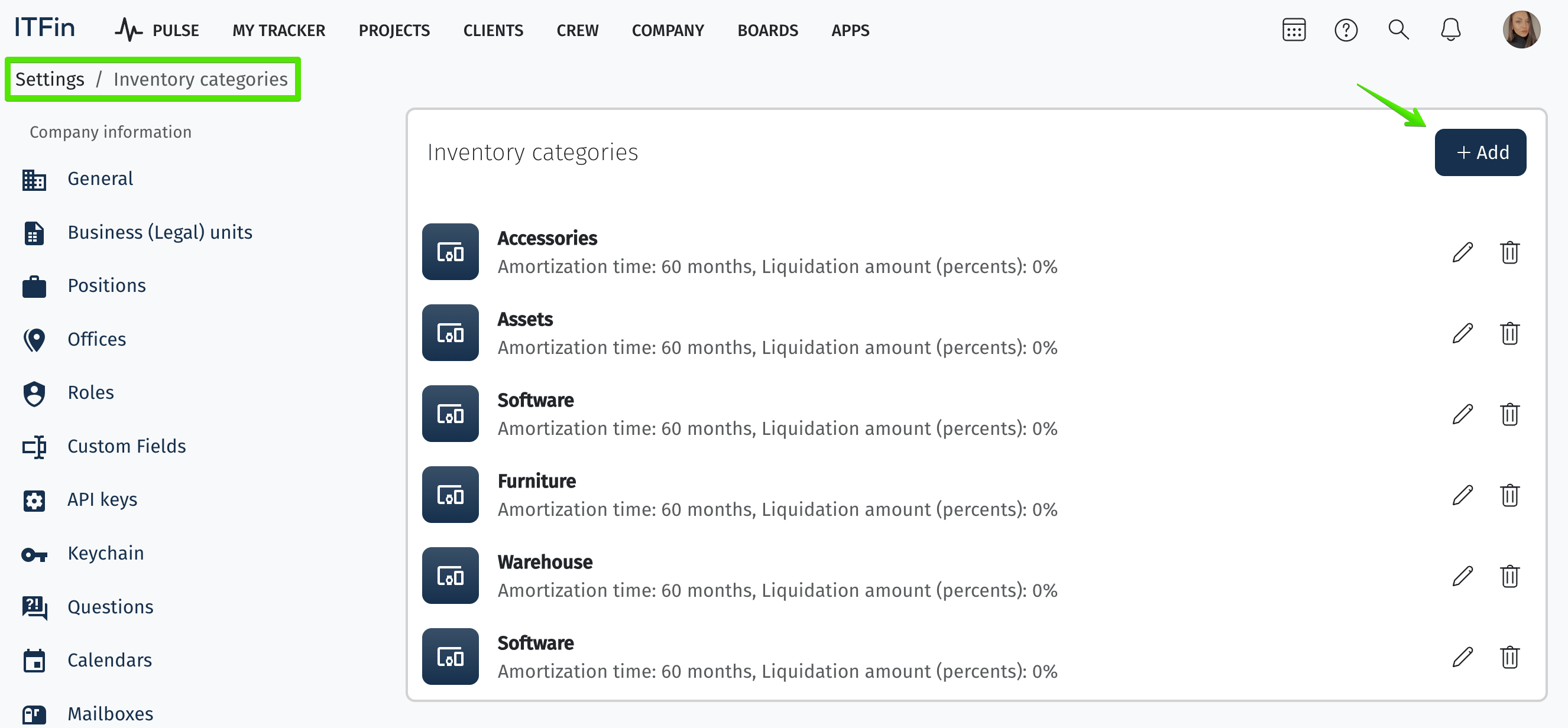
All items are divided into categories. You can set up depreciation for different categories. Next, specify the list of items, select the category, the employee, and their office. We can add them through Settings > Inventory Categories.
To add a new category, click the +Add button.
A modal window will appear for creating a new category. All fields marked with an asterisk are mandatory to fill out.

Liquidation amount defines the portion of an item's original cost that is not subject to amortization and remains on the balance sheet as residual (liquidation) value even after the amortization period ends.
Example: if an item's original cost is $1,000, the amortization term is 60 months, and the liquidation percentage is 10%, the system will amortize only $900 (90% of the cost) evenly over 60 months, while $100 (10%) will permanently remain as the item's residual value on the balance sheet — until the item is sold or written off.
If the liquidation percentage is 0%, the item is amortized in full down to zero residual value.
This residual value directly affects further operations with the item:
• on sale — the sale amount is compared against it to determine the gain or loss from the disposal;
• on write-off — this amount (the undepreciated remainder) is the one expensed to the company.